

Most people die with the majority of their potential going unrealized.
They either spend their lives:
Pulled in so many directions they never focus long enough to build anything meaningful.
So consumed by one domain it defines them entirely. They miss the potential fulfillment life has to offer.
Both paths lead to regret.
But that’s the fate most of us are given.
In school they teach you 10 subjects at once.
Scattering your finite attention and expecting you to remember it all.
Stuffing your brain with mostly useless facts.
Never explaining how those facts actually apply to your daily life.
You then enter college and the work force and they expect you to do the opposite. Pick one career at 18 years old that you’ll have forever.
If you don’t you’ll end up an outcast.
Working a fast food job at 50 being looked down on by your classmates who chose a path.
There’s a reason the creator economy is built on selling courses.
It’s exploiting a broken education system.
But that’s how society works.
It’s based in isolated extremes.
Never combining perspectives to gain a more holistic view of reality.
That’s the third path.
The one nobody talks about.
Not scattered learning with no clear focus.
Not unbroken tunnel vision.
Strategic Obsession.
A repeatable framework for learning anything.
A 60 day cycle of complete immersion in no more than 3 skills.
You obsess, build, and apply what you learn.
After 60 days, you rest, integrate, then pick your next skillset and repeat.
I discovered this system by accident when I was rebuilding my life.
Now I use it on repeat.
Obsessing over copywriting and content for 2 months.
Then pivoting to philosophy and business.
Then back to branding.
Each 60 day cycle builds a new skill or deepens an existing one.
This is how I turned my life around after hitting rock bottom, how I built the skills necessary to start my own business and over time how I started working with my first clients.
Resources:
At the end of the letter I provide a prompt to create your own Strategic Obsession Cycle.
First I’ll show you why it works and then I’ll show you how.
You never learned how to learn
Learning is a skill.
You’re conditioned to believe that in all parts of your life there is some big secret. Some hidden answer that when you find it it will all make sense.
Your problems will disappear.
This is the reason you end up lost in tutorial hell.
Never making any real progress.
Because searching for that one bit of information that makes it all work is addictive. You scatter your attention.
Learning 7 different things at a time hoping you’ll find the answer in one of them.
The endless search convinces your brain that you’re making progress.
That you’re one step closer to the solution.
But you’re not.
Here’s the real secret.
The answers are everywhere.
They’ve been staring you in the face.
The brightest minds in human history have uncovered many of the truths of the universe.
There are infinite YouTube videos about every topic that exists.
AI can teach you about any subject or help you learn any skill.
If you want to learn a language, get rich, or start a personal brand the answers you need are available.
The problem isn’t finding the answers.
The real problem is you don’t know how to see them.
Strategic Obsession is a system for learning how to learn.
How to:
Recognize good advice from bad
Retain knowledge that actually matters
Know what to learn and when
Build a skill stack that makes you irreplaceable
Here’s how it works:
Strategic Obsession
This is a framework based on 3 principles.
Creation
Collection
Immersion
The 60 day timeframe is just an example to give you a starting point.
60 days is ideal but these principles can be applied to 2 weeks, 3 weeks, 90 days, whatever you want.
Experiment and find what works for you.
This system works for a few reasons.
It’s meant to be intense:
Intensity increases neuroplasticity resulting in a higher retention of new skills.
It’s meant to be lived:
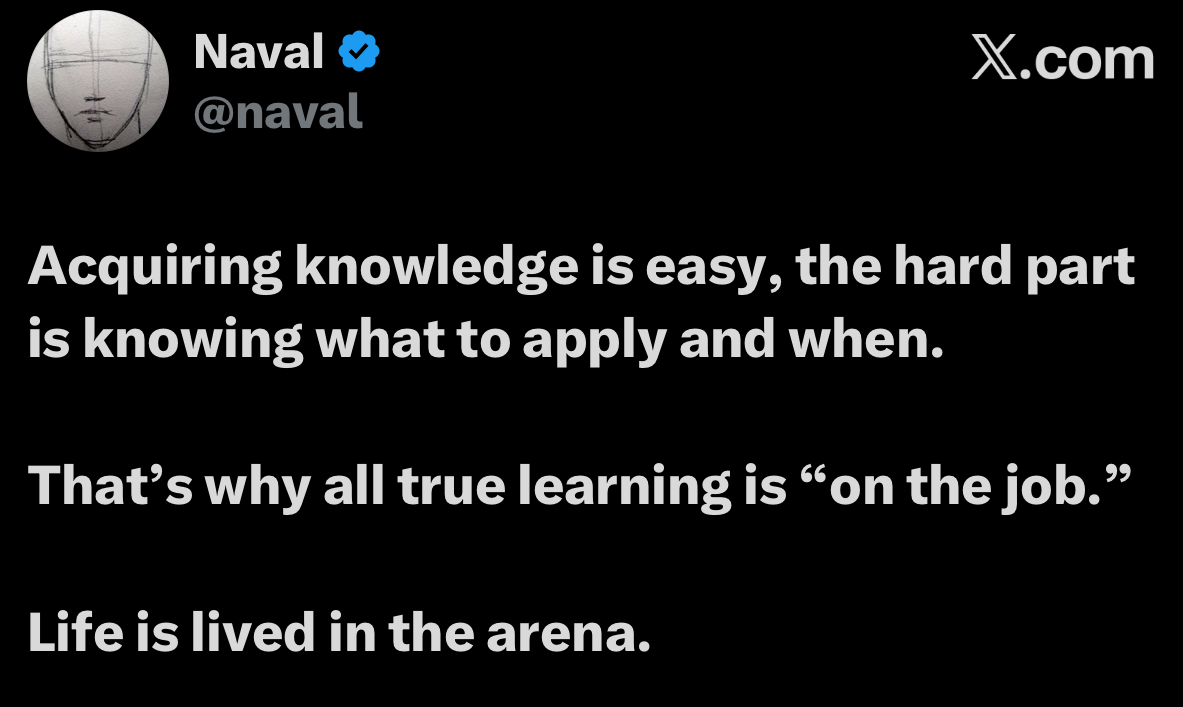
This isn’t a study guide, it’s an action plan.
What you learn will be immediately applied in real life.
Giving immediate feedback so you know what knowledge works and what doesn’t. What you need to know next becomes obvious so you never get stuck on what to learn.
It’s identity based immersion:
This isn’t 60 days of cramming.
You’re not studying for a test.
You are immersing yourself in new knowledge to the point that you identify with it. You’re not retaining, you’re becoming.
It’s a cycle:
This isn’t forever.
You get in the arena, you learn as much as possible, you rest.
After your 60 days you ramp down the intensity allowing for integration.
You’re then able to start a new cycle with a set of new skills and repeat.
You return to skills over time.
Constant learning of the same domain leaves no space to integrate new knowledge. You wouldn’t work out 2 hours a day and never take any rest days.
You’d end up in the hospital.
Your brain works the same way.
Once you go through the principles check out the prompt at the end to start your first Strategic Obsession Cycle.
Let’s begin.
Creation
“The purpose of knowledge is action, not knowledge”
— Aristotle
Goals
You’re going to build a project.
Start today.
Start with clarity.
Pick a goal.
Anything you learn should be learned for a reason.
Don’t pick skills or topics that sound impressive.
Build around a meaningful goal that requires you to learn the relevant skills to accomplish it.
You don’t accomplish anything in life until you know what you want.
That’s the reason most people can’t pay attention to one thing for more than 10 minutes.
They haven’t set a clear goal to direct their focus.
For example:
Instead of learning Japanese because you think it would make you more interesting.
You set a goal of traveling to Japan in 60 days and being able to hold basic conversations without a translator.
This sets immediate stakes.
You have a vision in mind and a timeline to make it happen.
This is structure and direction.
You don’t waste time learning skills irrelevant to your goal.
You start with learning conversation, not grammar or writing.
Because your goal is to hold basic conversations not write a blog in Japanese.
Without this structure your learning is directionless theory.
This is the leverage you need to actually retain new knowledge and skills.
Once you set a goal and test it in reality it becomes progress.
The point isn’t to accomplish the goal in 60 days.
That won’t always be possible.
The point is to create structure, direction, and intensity.
Write this down.
Your goal
Your 1-3 skills
Your timeline
Your goal should be:
Meaningful - You actually care about the outcome
Uncomfortable - It pushes your current capacity
Multi-skill - Requires learning 2-3 things simultaneously
The right goal naturally creates intensity.
It forces your brain to create new neural pathways.
If it requires too little effort there’s no challenge.
The information won’t register as useful.
If it requires too much effort you’ll become overwhelmed.
Which will lead to avoidance and burnout.
Projects
Start building.
Your project can be anything that has real world results or feedback.
This can be:
Content/newsletter about your learning
A business
A community to discuss
Something tangible (art, music, website)
Start doing the thing in whatever way you can.
If you’re learning photoshop, don’t start with tutorials.
Start by editing a photo.
If you’re building a brand, don’t start with your logo.
Start by making your first post.
This is the most important part of this process.
When you start you’re going to hit a wall.
This will tell you exactly what to learn next because you’re directly affected by the outcome of what you know.
Without a project you end up collecting information randomly, not knowing how it actually applies in reality.
Eventually discarding half of it when you actually start and realize what you really need.
Once you have your goal and start your project you can start applying the next principle in Strategic Obsession, Collection.
Collection
There is no one answer.
The answers you need are specific to you and your situation.
That’s one of the benefits of a project.
You need to develop a unique perspective that applies to your circumstances.
If you read my letter 'How to create content that spreads itself' then you’re familiar with the concept of consciousness transfer.
This is where someone else’s perspective collides with your own.
You absorb what they know and elevate your own consciousness.
You learn 10x faster by collecting the perspectives of others who have already accomplished similar goals.
Every experts knowledge is just one piece of a larger truth.
By learning from those who already have years of experience and specific knowledge you learn much faster.
Don’t look for information.
Look for perspectives that hold the information you’ll need.
Just like you picked skills based on a goal.
You learn information based on perspectives.
Take pieces of their strategies and knowledge that work for you and discard the rest.
True intelligence comes from combining multiple perspectives on reality and finding the truth in all of them.
Keeping what works and developing your own way.
Collect as many perspectives on how to achieve your goal as possible.
Watch YouTube videos
Podcasts
Read books
Talk to AI
Find as many methods, mental models, frameworks, systems as you can.
Write them down.
Create a database.
You’ll naturally gravitate towards certain people, methods, systems etc.
But don’t overlook perspectives that don’t attract you at first.
All perspectives hold some form of truth.
Discard what doesn’t work or resonate.
What’s left becomes your training ground to develop your own unique perspective.
That’s when you can start applying the next principle in Strategic Obsession, Immersion.
Immersion
This is what really separates Strategic Obsession from other frameworks.
Complete immersion.
Take your perspectives, frameworks, methods, mental models, systems.
Start immersing yourself on a daily basis.
This can look like:
Reading while you make coffee
Listening to podcasts and audio books while you do chores and commute to work
Do 1 hour of deep work first thing in the morning
The point is that it should be done consistently throughout your day.
Don’t try to retain everything at this point.
Immersion isn’t about effort it’s about frequency.
How much you’re exposed to what you’re trying to learn.
This is where you’ll want to quit.
Nothing will make sense at first.
Concepts will be confusing, the process will be difficult.
The confusion you feel is your subconscious sorting information.
This is where you have to trust the process more than your conscious mind.
Your brain processes information on two levels.
Conscious and subconscious.
In ‘Thinking Fast and Slow’ by Daniel Kahneman he describes these as System 1 and System 2.
System 1 operates automatically and quickly, with little or no effort and no sense of voluntary control.
System 2 allocates attention to the effortful mental activities that demand it, including complex computations. The operations of System 2 are often associated with the subjective experience of agency, choice, and concentration.
Immersion trains system 1, the automatic, subconscious system.
Immersion does two things simultaneously:
First:
It builds pattern recognition without conscious effort.
Second:
It reshapes your identity at the subconscious level.
The second one is more important.
The key to learning anything deeply in a short amount of time is actually identifying with what you’re learning.
Being consistently exposed to new information changes your association with it.
Instead of identifying as someone who’s trying to learn branding.
You start to identify with branding itself through constant exposure and application to a project.
The goal isn’t to rewire what you know.
It’s to rewire who you are.
When you identify as the thing you’re learning, retention is automatic.
You don’t have to force yourself to remember it.
You are it.
Your brain starts to see it as necessary for survival.
You begin making connections in your everyday life that relate to your skills.
You see solutions for your project everywhere.
That’s the shift from student to practitioner.
That’s when learning accelerates exponentially.
When things start to click it becomes a feedback loop.
Your project shows you what skills matter and what to learn next.
Immersion embeds the information in your subconscious so you see the solutions your project primed you for.
Strategic Obsession Prompt
Subscribe to receive the prompt and start your own Strategic Obsession cycle today.
The prompt will help you determine your Goal, Skills, and Timeline.
It will also give you resources and suggestions for your Creation, Collection, and Immersion based on your specific goals.
If you’re already subscribed you should have received a separate email with the prompt.
The Takeaway
Strategic Obsession is how you learn 10x faster and more effectively.
After your 60 days, ramp down your intensity for 2 weeks.
Rest.
Then start again with new skills or repeat the same set to deepen further.
It’s a feedback loop of intense immersion and building.
Creating more progress in 60 days then you would make in 6 months of scattered focus.
Each cycle compounds.
The copywriting sharpens your philosophy.
The philosophy deepens your branding.
The branding gives meaning and structure to it all.
This is how you build an irreplaceable skill stack.
Over time you see how all your skills intertwine and you build your own unique perspective.
DM me.
Let’s talk.
What’s your first Strategic Obsession cycle going to be?
What skills are you developing?
‘Til next time.
Don’t betray yourself.
Don’t scatter.
Don’t tunnel vision.
Strategically obsess.
Become irreplaceable.
— Edamame Dufflebag
How to apply this in schools? So thought-provoking!