

Most creators are forgettable.
There’s thousands of accounts that you’ve liked online that you’ll never think about again.
Because 90% of creators get one thing wrong.
They think their content is about them.
They think it’s about who they are, what they know, or what they do.
It’s not.
Their ideas don’t stick because they don’t change you.
Their worldview doesn’t combine with yours in an effort to elevate your consciousness.
Bringing you closer to your goals and highest potential.
Most creators share information.
And that’s why most of them are ignored.
The ones that leave a meaningful impact transfer consciousness.
Think about any influential creator.
You’ll realize that you don’t remember the tips they gave you.
You remember their worldview.
How they think about life.
Their perspective collided with yours and upgraded your understanding of your own life and reality.
Mastering this skill is the only way to create impactful work.
Work that spreads on its own because people don’t just like your ideas, they adopt them as theirs and share them with the world.
Last week I introduced the concept of consciousness transfer in “The death of skill (and what comes next).”
This week, I’m showing you exactly how to use it.
What people actually want
In order to transfer consciousness you first have to understand the psychology behind why it works.
People are predictable.
Individuals may not be, but humans in general are.
We follow certain patterns and rarely have the awareness required to break out of them.
Here’s why that’s important.
Most people think they want money, love, and a good physique.
But what they really want is security, certainty, and connection.
Money is security in disguise
A good physique provides certainty of health, safety, power and status
Love is just the deepest form of connection
This is how everything is.
Everything we want in life can be distilled into a list of basic human desires.
“Man admires and often tries to exaggerate whatever characteristics nature may have given him.”
— Charles Darwin
The point is this.
We’re all trying to solve the same problems.
The monk and the billionaire want the same thing they just go through different routes to get it.

When someone watches or reads your content, they’re not just there to hear your thoughts.
They’re there to solve their problems.
Your job is to help them go from one state to the next.
State 1:
Being the person who has the problem
State 2:
Being the person who solves the problem
Here’s how to use consciousness transfer to do that and leave an impact on your audience.
Transformation through transfer of consciousness
When you consume content you’re not hearing words you’re absorbing consciousness.
This newsletter is a piece of my consciousness.
It’s colliding with yours and you’re absorbing whatever you resonate with and believe will solve your problems or help you live a better life.
That’s the power of consciousness transfer.
My goal is not to tell you what I think.
It’s to show you why what I think matters to you.
Your perspective is a collection of all the things you believe about life.
All the ways you’ve solved the existential problems we all face.
Your content transfers that perspective.
When someone consumes it, they’re not just learning your methods, they’re absorbing how you see the problems.
That’s what sticks.
Understanding yourself is the key to understanding your audience.
What you want is the same thing that they want.
If you have problems with:
Money
Health
Business
Relationships
Spirituality
So do they.
Your unique perspective (or consciousness) is how you solve these problems.
You will solve your money problems differently than someone else would.
You solve them by building an audience.
Someone else solves it by climbing the corporate ladder.
Same problem, different consciousness.
The key to making impactful content is showing the person who climbs the corporate ladder why your solution of building an audience is important to them.
That’s how your consciousness transfers.
You create a bridge.
If you don’t show them why it would be beneficial to them your perspectives will bounce off each other.
It’s not about saying “building an audience is the best way to make money.”
It’s about saying “building an audience is how you build a strong network, resume, and portfolio.”
This is a language the person climbing the corporate ladder understands.
Your perspectives will be more aligned and they will start to absorb how you view the world.
Their perspective shifts and they start to adopt your vision, leading them to the same interests you have and investing deeper in your worldview.
This is just one example to paint a picture of what it means to transfer consciousness.
Here’s how to actually use this to create your content.
1. The Toolkit
You start by collecting consciousness.
You need to curate your own perspective by collecting the perspectives of others.
Then you keep what works for you and create your own way.
You’re going to solve your own problems by gathering as many perspectives as possible.
Consume:
Books
Podcasts
Interviews
Music
Art
Movies
Shows
Let them absorb into your own consciousness.
Collect ideas, beliefs, tactics, mental models, skills, and abilities.
Stress test them against your own reality.
Don’t just write them down actually put them into action and see what works for you.
Document your process.
Keep what works and delete the rest.
After testing so many avenues and taking pieces from each you start to create your own unique solution or perspective on solving the problem.
This is how you differentiate yourself.
You build content around how you think, not just what you think.
2. The Target
Once you have your own unique worldview you have to understand how people will actually adopt it for themselves.
Most creators make the mistake of niching down.
That’s why they’re forgotten.
They pick very specific topics to talk about so they can target a certain audience of people.
The problem is that it only attracts people who are already interested in that topic.
They’re missing the point.
Your goal isn’t to teach people about a topic they’re already interested in.
They can go to ChatGPT for that.
Your goal is to share how you see the world because that’s what transforms people.
They don’t need to be interested in your niche to care about it.
You can show them why they should care about it.
That’s what they remember.
They don’t remember you for a video about “My Morning Routine.”
They remember you for a video about “How I Stopped Wasting Time and Started Building Something That Matters.”
Same video but one speaks to more people.
Here’s the point.
You want to start with broad problems that everyone faces:
Money
Health
Relationships
Meaning
Then show them your specific perspective on how to solve those problems.
This is how you build an audience of people who care about how you think not what you know.
This teaches people who are 2 steps behind you.
It shows your expertise and foundational knowledge to people on your level.
3. The Transfer
Now that you understand how to meet people where they are (universal problems), you need to understand how to guide them into your worldview (specific solutions).
This is where your pillars come in.
Your pillars are the specific ways you solve those universal problems.
They’re not random topics.
They’re the lens through which you see everything.
They come from the systems and solutions you developed by curating your consciousness.
For example:
My 3 pillars are branding, creative direction, and self-development.
These are things I discovered solving my own problems and gathering different perspectives to create my own.
I wrote a newsletter recently titled
“How to get what you want out of life.”
That’s a universal problem.
But the newsletter’s actually about how to create a personal brand as a self-development tool.
You use that tool to become the person who gets what you want out of life.
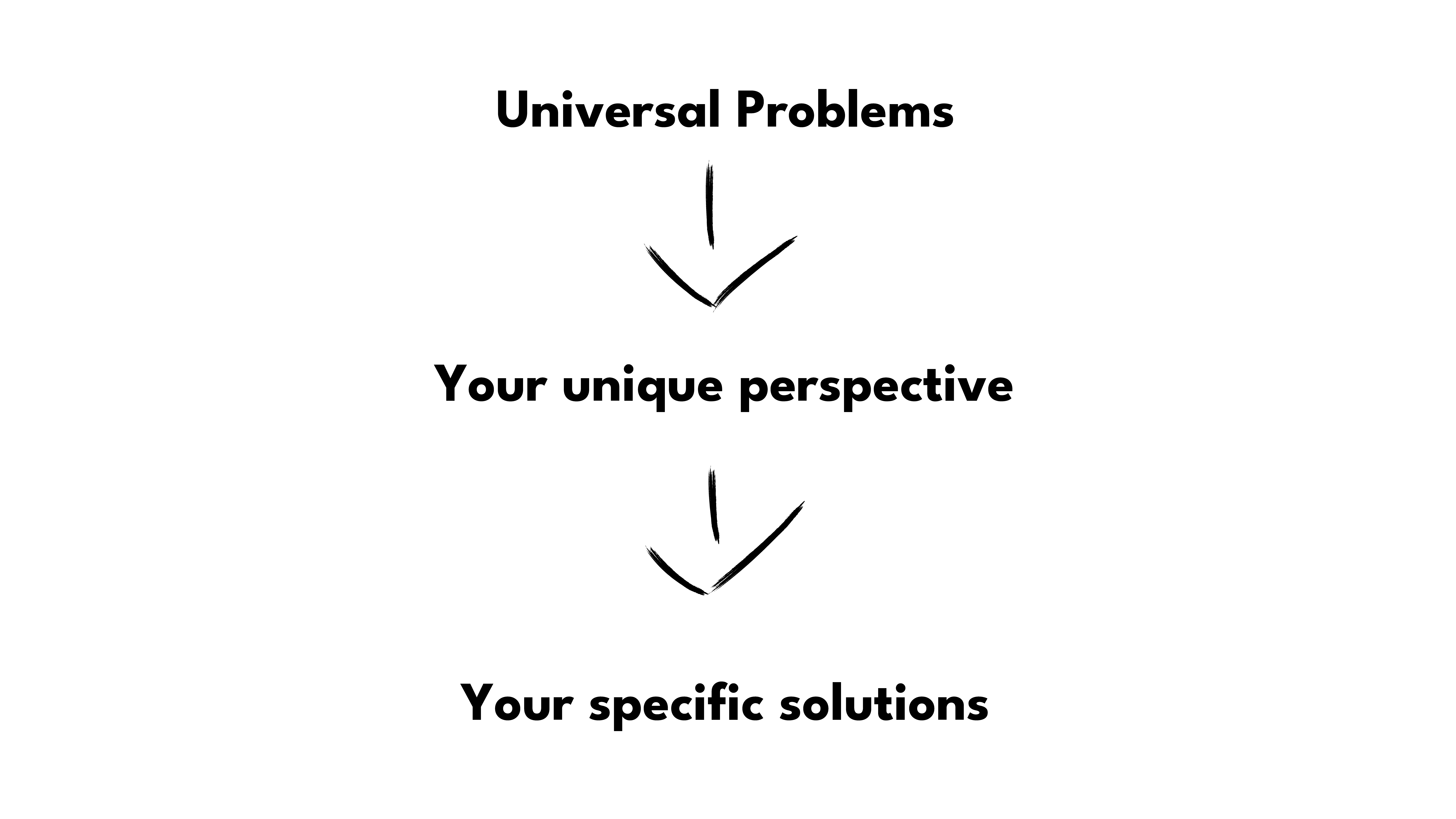
Notice the pattern:
Universal problem
My unique perspective on it
My specific solution related to my pillars
Pick 3-5 topics that you’re interested in the most.
Things you can talk about endlessly.
Things you discovered while curating your consciousness and exploring your own solutions to problems.
These become the lens that you view universal problems through.
This is how you’ll help your audience go from:
State 1:
Being the person who has the problem
to
State 2:
Being the person who solves the problem
The Takeaway
If you want to create ideas that spread themselves you don’t transfer ideas.
You transfer consciousness.
You curate your own unique worldview.
Show people why it matters to them using universal problems.
And transfer your worldview to combine with theirs and improve their lives using your perspective.
DM me your biggest takeaway from this.
Let’s talk.
‘Til next time.
Don’t Betray Yourself.
Curate your consciousness, solve your problems, transfer the solutions to the world.
— Edamame Dufflebag
I write a Substack series called Fire Returned to Heaven, transcripts from solitary prayer walks.
Your piece on “consciousness transfer” gave me more clarity on how to share them so readers know why they might care.
Your post gave me the idea to frame each walk by naming the mechanism that unfolded in me (fear turning into trust, control dissolving into rest) in language that is applicable to anyone’s life.
If that resonates, they can then enter the full transcript and see it play out in detail.