

The easiest way to live a life you hate is to never believe in yourself.
That’s why most people accept lives they don’t want.
They either end up endlessly dreaming of someday.
Or resenting everyone and everything, and blaming their circumstances.
That’s what makes imposter syndrome so dangerous, it gives you every reason to submit to a ‘safe’ but unfulfilling life.
High agency and self belief is a common trait among the most successful people.
They don’t fold under the pressure of what others think.
They make decisions based on their own worldview and trust their instincts.
Doubt doesn’t determine them.
Imposter syndrome isn’t something to submit to but navigate consciously.
But when you grow up in a system that values safety, conformity, practicality over self expression and trust in unquestioned knowledge.
It’s so easy to give in.
Standing on the risk of your own decisions becomes very shaky ground.
It takes courage.
But here’s the thing.
Courage is a copout.
If you need courage to believe in yourself, you never really did.
It’s not about you.
It’s about how you relate to your environment.
Imposter syndrome isn’t proof you’re a fraud.
It’s proof you’re judging yourself through a broken context.
It’s impossible to believe in yourself when the weight of everyone else’s experience and opinion are more valid than your own.
Courage won’t save you.
Clarity, consistency and context will.
Let’s look at how imposter syndrome starts and then I’ll show you how to escape it.
We judge the content of our lives.
Judgment rules our life.
It’s a tool for survival, that’s how we evolved.
If we can’t judge what foods are safe vs. poisonous we’ll never eat anything out of fear.
Or we’ll eat the wrong thing and die.
We’re judging everything all the time.
You judge:
Your best friend as someone who’s funny, encouraging and fun to be around.
Your job as an unavoidable responsibility.
The sushi spot down the street as your girlfriends favorite place to eat.
Bears, guns, tornados and the enemy as dangers to be avoided.
This is how we know what’s safe, where we belong and what we like.
But we also judge ourselves:
I am a reader.
I’m awkward.
I believe in justice, discipline and that the original Ninja Turtles movies are a perfect trilogy.
This is how our identity is formed.
Through judgement.
But judgement is a double edged sword.
If you’re not using it consciously it will destroy you.
This is how people waste their entire lives.
By being dictated by other peoples judgement.
Escaping imposter syndrome isn’t about judging yourself less or just not caring what others think.
It’s about changing your relationship with judgement.
For example take Virgil Abloh.
He was trained as an architect, not a fashion designer.
When he entered the industry, critics dismissed him as an outsider, he wasn’t a “real” designer.
He used that judgement as fuel.
He built Off-White, redefined the line between streetwear and luxury, and eventually became Artistic Director of Louis Vuitton Menswear.
Successful people aren’t immune to insecurity, they just realize that not all judgements are valid or accurate and then act anyway.
Imposter syndrome is a result of a judgement system that turns on you.
Lacking self esteem and agency in your own decisions is the quickest way to never accomplish anything meaningful.
If judgement’s the cause how do we take control of our judgement, our lives and create meaningful work?
Perspective = Context
We’re constantly filtering our reality through our unique perspective.
All the experiences, beliefs, and knowledge we’ve encountered.
That’s how we decide how to judge things.
Based on the context we’ve been exposed to throughout our lives.
If you’re drowning in debt money’s a prison.
If you’re rich money’s a tool for freedom, leverage and opportunity.
Money didn’t change, the perspective did.
If you’ve never trained the gym is pain, failure, and potential embarrassment.
If you’re a bodybuilder it’s empowerment, strength, and community.
The gym didn’t change the perspective did.
You see the pattern here.
When the perspective changes the judgement changes.
What we experience isn’t based on what we see but how we see it.
Identifying as an awkward person isn’t a bad thing.
Look at Nathan Fielder.
He’s built an entire career with multiple critically acclaimed shows from being awkward.
But if you see being awkward as weird and uncomfortable.
You’ll judge yourself as weird and uncomfortable.
This will change how you behave.
You’ll avoid parties, social settings, job and business opportunities, creative expression.
This is how perspective and judgement start to dictate your life and reality.
This is imposter syndrome in action.
You make a judgment about yourself based on your context of what successful people look like.
And decide your not them, you’re a fraud.
Here’s the truth in reality you have no idea what a successful person looks like.
No one does.
How to escape imposter syndrome
1. Content vs Context
I discovered this concept in a David R. Hawkins book.
I believe it was ‘I, Reality and Subjectivity’.
It changed my life, my view on myself and the universe.
Over time I went from valuing everyone else’s opinion over mine.
And waiting for my life to happen but never making it happen for myself.
To starting over with my content and brand, building from my own worldview, beliefs and interests.
Not following trends but creating my own way as the foundation of my one person business.
If you focus on this concept long enough it will destroy your imposter syndrome.
Here’s the idea.
Content
This is anything you focus on.
In this example, we’ll use a can of beans.
Context
Everything else.
So everything that exists other than our can of beans.
To understand the true nature of our can of beans you have to understand its entire context.
This includes everything that happened to bring this can of beans into existence since the beginning of time.
And everything that will happen in the infinite future because of its existence.
You’d have to know where the beans were harvested, where the metal from the can was mined, how the mine was formed, how the workers in the factory shaped the metal into the can.
Even what each worker ate for breakfast in order to make it to work on time.
If they didn’t the factory wouldn’t open and the can couldn’t be made.
This can go on and on forever.

Your context shapes your perspective which shapes your judgement.
The point is, in order to truly understand something we need full context.
But that’s not how it works, we judge everything, ourselves and others through our own limited context.
Based on our very specific life, experiences, beliefs etc.
You’ve only experienced .00001% of reality but you use that to interpret 100% of it.
You judge the can of beans based off your experience and knowledge of beans.
Every successful person you look up to you only see through what you know about them.
You know the polished, successful, curated version.
You don’t know the years of struggle, doubt, failure, and work that built them into who they are now.
Their success is a result of everything in their life, their entire context, which you’ll never understand.
You do this with everything and everyone, including yourself.
You judge yourself from your current context, but not your future context.
The version of you who’s building the business isn’t the version who has built it.
Current context:
You’re filled with doubt, shame, insecurity
You don’t know what you’re doing
Surrounded by others success
Don’t have enough experience to have proof of your abilities
You feel like a fraud
Future context:
Has confidence in their skills and abilities
Has experience and a stack of proof
Knows taking risks is how you get ahead
Realizes doubt isn’t a sign to stop but a sign you’re extending you comfort zone
Imposter syndrome happens in-between these two stages.
It comes from having to bridge the gap of becoming someone new.
When you start you don’t have enough evidence to identify as someone who knows what they’re doing.
It doesn’t mean you’re a fraud it means you have work to do.
Success happens in stages.
The Success Loop:
Learn
Develop skill
Complete projects to stack proof
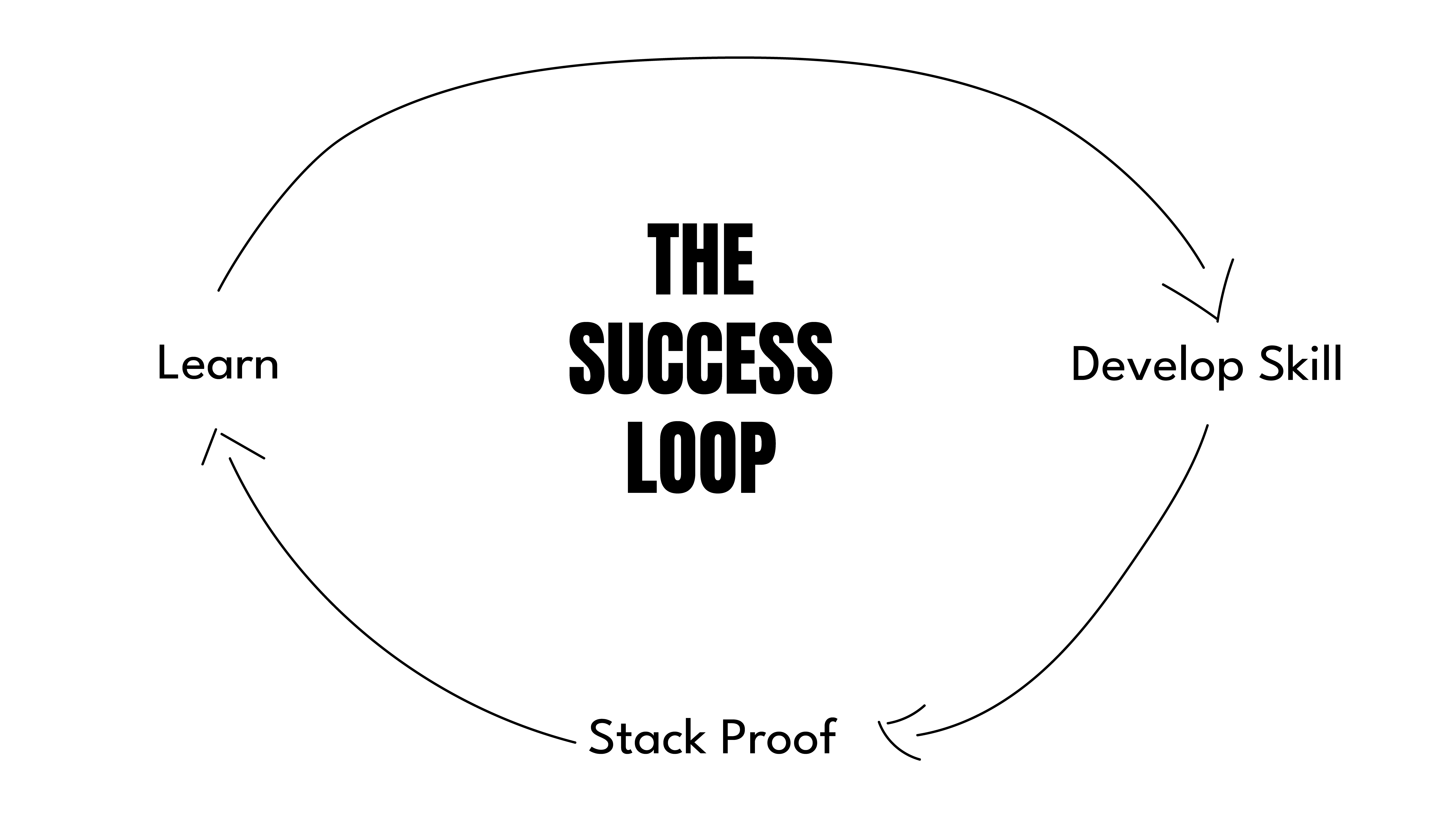
Each time you complete the loop you develop more skill and stack more proof of your success.
As you progress, take risks and your skills and abilities grow turn into someone who identifies with that success.
2. Zoom Out
If you are constantly suffering from self doubt and criticism.
And avoid taking risks and growing because you’re unsure.
It’s not because you’re incapable, it’s because your context is broken.
You have to change your context to change your judgement.
If your life is filled with people, experiences, thoughts and beliefs that make you feel:
Frustrated
Trapped
Misunderstood
Insecure
That’s a limiting context.
That dictates what’s possible in your life.
It will control what opportunities you see, how you feel about yourself and how you see others.
In order to escape imposter syndrome you need to fill your life with examples of:
Success you want to have
Skills you want to acquire
Beliefs you want to adopt
Knowledge and experience that increases your sense of possibility
You do that by consuming the right media, changing your environment and meeting new people.
Learn about new cultures, lifestyles, skills, creative domains.
Get a wider view of what life could be.
You’ll never have a new path if you can’t see a new path.
3. Consume on purpose
To build a new worldview because that’s what we’re doing here.
We’re creating a new understanding of what it means to be successful.
You have to create a new understanding of the world and the possibility it holds.
Here’s how you start changing your context and stop feeling like a fraud.
Choose 5 people you admire the most (This can be more than 5 that’s just a start):
Make these people who have success in their field and lives you want to emulate.
Create lists of their content, this can be books, movies/shows, interviews, lectures, music.
The more the better, start consuming from this list regularly, learn what makes these people impactful to you.
Whatever you admire about them says something about you.
It’s either a trait, skill, or characteristic you already have or one you want.
This is evidence that you’re more successful than you believe, you’re more like them than you think.
The more you surround yourself with them the more you’ll start to identify with these traits.
Use AI:
Start a new chat with this list of people ask:
Here are 5 people that I admire (insert here): Notice patterns between these people, what kinds of skills, traits and principles do these people exhibit and what does that say about what I want out of life?
What specific skills should I learn to build that kind of life?
What should I surround myself with to build that kind of life?
What should I avoid or cut from my life and surroundings to build that kind of life?
This will give you a map for building a life that supports your goals and success.
Surround yourself with media, people, habits, environments, ideas and beliefs that serve the life you want to build.
The Takeaway
Imposter syndrome’s not evidence you’re a fraud.
It’s evidence that your context is limited and your perspective is broken.
When you start to fix what you know, surround yourself with and believe.
You’ll realize success isn’t something you achieve but a process you’re always in the middle of.
DM let me know what kind of work you do, what your goals are and how your context will help you get there.
We can talk about the journey of success.
CONNECTION.
COMMUNITY.
‘Til next time.
— Edamame Dufflebag
So much food for thought within one article, I will be coming back to it again and again. Excellent job putting it together like that. I feel like I need to read each section, even each line separately and sit with it for a few minutes and ponder it. Each one.
Thank you. This was a very hit me square on piece this morning.